


QSFP+ transceiver can be inserted into all devices with QSFP+ interface (and some devices with QSFP28 interface) to realize 40G network connection. Generally speaking, there are two types of 40G QSFP+ transceiver interfaces: LC duplex interface and MTP/MPO interface. The two have obvious differences in transmission distance, optical cable type and whether 4x10G transmission can be realized.
The four types of optical transceivers, 40GBASE-SR4, 40GBASE-CSR4, 40GBASE-PLRL4, and 40GBASE-PLR4, are all MTP interface transceivers, and are suitable for situations where 4 10G Ethernet interfaces need to be connected.
40GBASE-SR4 optical transceiver is the most commonly used transceiver in 40G short-distance transmission. 40GBASE-SR4 optical transceivers are often used with multi-mode optical fibers-the transmission distance is 100 meters when matched with OM3 fiber jumpers; the transmission distance is 150 meters when matched with OM4 fiber jumpers. There are 4 independent optical signal transmitting and receiving channels inside the transceiver. Each channel can support 10Gbps data transmission, realizing high-bandwidth 40G transmission.
Both the 40GBASE-CSR4 optical transceiver and the 40GBASE-SR4 optical transceiver have MTP interfaces, and both have the same working principle. 40GBASE-CSR4 optical transceiver can be matched with 12-core MTP (female) fiber jumper to realize 40G optical transmission; or with 8-core MTP (female)-4*LC duplex branch jumper, it can be connected with 4 10GBASE-SR optical transceivers to achieve 4X10G optical transmission. As an upgraded version of SR4, the 40GBASE-CSR4 optical transceiver has a maximum transmission distance of up to 300 meters (with OM3 fiber jumper) or 400 meters (with OM4 fiber jumper).
Generally speaking, there are two basic modes of data transmission-serial and parallel. Parallel transmission refers to the simultaneous transmission of multiple bits of data on different channels on the same optical fiber. 40GBASE-PLRL4 optical transceivers, SR4 transceivers and CSR4 transceivers all adopt the principle of parallel transmission, and are usually connected with MTP connectors. But different from the two kinds of optical transceivers introduced above, the 40GBASE-PLRL4 optical transceiver supports long-distance transmission, and the transmission distance on single-mode fiber can reach 1 km or 1.4 km.
The 40GBASE-PLR4 optical transceiver with MTP interface also uses the parallel transmission principle described above. Like the 40GBASE-PLRL4 optical transceiver, it can also use single-mode branch jumpers to connect the transceiver to four 10GBASE-LR optical interfaces to realize 4X10G transmission. Like the 40GBASE-PLRL4 optical transceiver, the 40GBASE-PLR4 optical transceiver is also used for long-distance transmission, but its transmission distance is longer, up to 10 kilometers.
The five types of optical transceivers, 40GBASE-BiDi, 40GBASE-UNIV, 40GBASE-LR4, 40GBASE-LR4L, and 40GBASE-ER4, are all LC interface transceivers, of which only 40GBASE-BiDi is used for short-distance transmission through multi-mode fiber.
Different from other transceivers, the 40GBASE-BiDi optical transceiver is special in that it has only 2 independent 20Gbps optical signal transceiver channels. Each transceiver channel can simultaneously transmit and receive optical signals of different wavelengths from a multimode fiber. Usually used with LC multi-mode fiber jumpers. It is worth mentioning that the 40GBASE-BiDi optical transceiver can realize 40G transmission without changing the existing 10G multimode fiber cabling system. 40GBASE-BiDi optical transceiver can transmit 100 meters through OM3 fiber patch cord or 150 meters through OM4 fiber patch cord.
"UNIV" means universal. The 40GBASE-UNIV optical transceiver can be used with single-mode fiber or multi-mode fiber without changing the transceiver configuration or adding other hardware devices. When using this transceiver for wiring, the time and cost of wiring can be reduced to a certain extent. The 40GBASE-UNIV optical transceiver has 4 channels inside, and each channel can transmit or receive 10G signals. After being combined by a multiplexer, two optical fibers are used for 40G transmission. When paired with multimode fibers OM3 and OM4, the transmission distance is 150 meters; when paired with single mode fibers, the transmission distance is 500 meters to 2 kilometers (depending on different suppliers).
As mentioned above, 40GBASE-SR4 optical transceivers are widely used in short-distance transmission, while 40GBASE-LR4 optical transceivers are the most commonly used transceivers in long-distance transmission. The 40GBASE-LR4 optical transceiver uses a duplex LC interface, which can transmit up to 10 kilometers through a single-mode jumper. This kind of optical transceiver has 4 independent transmitting and receiving signal channels. The optical signal at the transmitting end passes through the multiplexer to combine all wavelengths for transmission, and the transmitted signal is decomposed into 4 transmission rates by the demultiplexer at the receiving end. It is a 10Gbps channel.
The 40GBase-LR4L optical transceiver and the 40GBase-LR4 optical transceiver have the same working principle, and both realize 40G long-distance data transmission through single-mode jumpers. The difference between the two is that the 40GBase-LR4L optical transceiver has a maximum transmission distance of only 2 kilometers.
The last transceiver 40GBASE-ER4 to be introduced has the same working principle as the previous two transceivers LR4 and LR4L. It uses an LC duplex interface with a single-mode jumper. The 40GBASE-ER4 optical transceiver is the longest transmission distance among the nine transceivers introduced in this article, up to 40 kilometers.
The detailed information and comparison of the above nine transceivers are shown in the following table:
Inteface Type | Patchcord Type | Wavelength | Transmission Distance | Other name | |
SR4 | MTP | MM | 850nm | 100mOM3;150mOM4 | iSR4 |
CSR4 | MM | 850nm | 300mOM3;400mOM4 | XSR4/ESR4/SR4E/eiSR4 | |
PLRL4 | SM | 1310nm | 1km or 1.4km | PIR4/LRL4 | |
PLR4 | SM | 1310nm | 10km | / | |
BiDi | Duplex LC | MM | 832nm-918nm | 100mOM3;150mOM4 | SR-BD/SR-BiDi |
UNIV | SM/MM | 1310nm | 150mOM3/OM4 SM;500m to 2kmSM | LX4/LM4 | |
LR4L | SM | 1310nm | 2km | IR4 | |
LR4 | SM | 1310nm | 10km | / | |
ER4 | SM | 1310nm | 40km | / |
CFP (C form-factor pluggable) is an optical transceiver transmission protocol formulated by the CFP MSA organization for high-speed digital signal transmission. This agreement mainly serves 100G Ethernet at first, but can also be used in 40G network. There are mainly three types of 40G CFP encapsulated optical transceivers: 40GBASE-SR4 CFP optical transceiver, multi-mode OM4 jumper with MTP interface, data transmission 150 meters; 40GBASE-FR CFP optical transceiver, single-mode with duplex SC interface Use jumpers together, the transmission distance is 2 kilometers; 40GBASE-LR4 CFP optical transceiver, the transmission distance can reach 10 kilometers.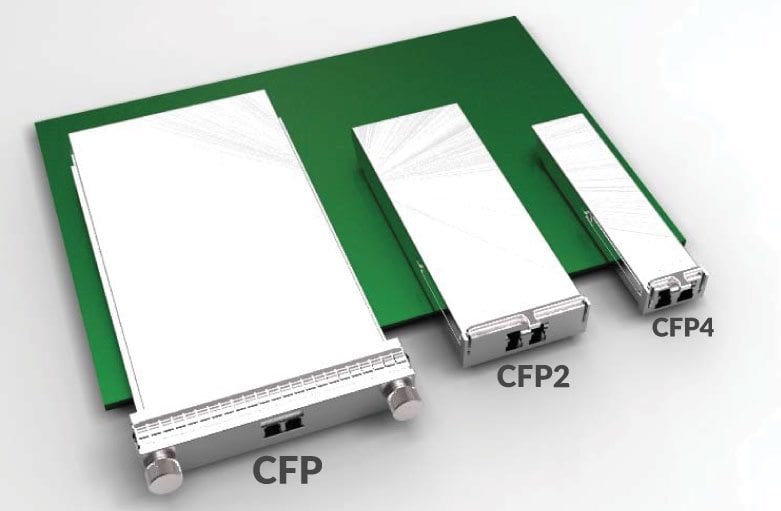
The main differences between QSFP+ optical transceivers and CFP optical transceivers are reflected in the following aspects:
1. Appearance: CFP optical transceivers are obviously larger in size (prices are generally higher);
2. Interface type: CFP optical transceiver uses MTP or duplex SC interface, while QSFP+ optical transceiver uses MTP or duplex LC interface;
3. Transceiver types: CFP optical transceivers have limited types, and QSFP+ optical transceivers, in addition to the nine common transceivers described in this article, have other models that support different transmission distances to meet the needs of different users.
QSFP+ optical transceiver integrates the characteristics of small size, low cost, high flexibility, and wide applicability. Compared with CFP optical transceiver, it is more favored by users.
Research shows that the optical transmission bandwidth in the field of communication networks urgently needs to be upgraded from the original 10G to 40G or even 100G. 40G QSFP+ optical transceiver can realize high-density, low-cost, low-power 40G data transmission, and has a good development prospect.
Nowadays, there are many 40G optical transceiver products on the market. How to distinguish between different categories and choose the optical transceiver that suits your needs is particularly important.