

Hey there! I'm a supplier of CWDM AWG (Coarse Wavelength Division Multiplexing Arrayed Waveguide Grating) products, and today I wanna chat about whether CWDM AWG can be used in government agency networks.
First off, let's get a bit of background on CWDM AWG. It's a pretty nifty technology that allows multiple signals of different wavelengths to travel over a single optical fiber. This is super useful as it can significantly increase the capacity of a network without having to lay down a bunch of new cables.
Now, government agency networks have some unique requirements. They need to be highly reliable, secure, and able to handle large amounts of data. And let me tell you, CWDM AWG has a lot going for it when it comes to meeting these needs.
Reliability
Reliability is key for government agency networks. These networks are used for all sorts of important tasks, like handling sensitive information, coordinating emergency responses, and facilitating communication between different departments.
CWDM AWG is known for its high reliability. The arrayed waveguide grating structure is designed to be stable and resistant to environmental factors. It doesn't rely on moving parts, which means there's less chance of mechanical failure. This stability ensures that the network can keep running smoothly, even in challenging conditions. For example, in areas with extreme temperatures or high levels of humidity, a CWDM AWG - based network can still maintain its performance.
Security
Security is another major concern for government agencies. They deal with classified information, so any network they use needs to have top - notch security features.
CWDM AWG can contribute to network security in several ways. Since multiple wavelengths are used on a single fiber, it's easier to separate different types of traffic. For instance, sensitive data can be transmitted on a dedicated wavelength, which adds an extra layer of protection. Also, the optical signals used in CWDM AWG are harder to tap into compared to traditional electrical signals. This makes it more difficult for unauthorized parties to intercept and access the data being transmitted.
Capacity
Government agency networks often need to handle a large volume of data. With the increasing digitization of government services, there's a growing demand for high - speed data transfer.
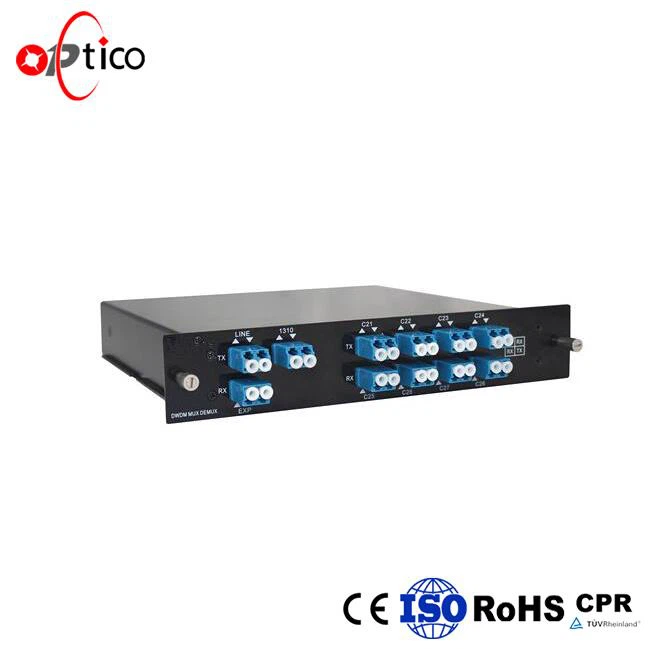
CWDM AWG can help meet this demand. By multiplexing multiple wavelengths onto a single fiber, it can significantly increase the network's capacity. For example, we offer products like the Rack Mount 8ch CWDM 16 Channels CWDM, which can handle multiple channels of data simultaneously. This means that government agencies can transmit more data, such as large files, video streams, and real - time sensor data, without experiencing bottlenecks.
Cost - effectiveness
Cost is always a consideration, even for government agencies. They need to make the most of their budgets while still getting high - quality network solutions.
CWDM AWG is a cost - effective option. Compared to some other high - capacity networking technologies, it doesn't require as much expensive infrastructure. The equipment is relatively affordable, and since it can increase the capacity of existing fiber optic cables, there's no need to invest in large - scale cable installations. This can result in significant cost savings for government agencies over the long term.
Compatibility
Government agency networks are often a mix of different technologies and systems. It's important that any new networking equipment can be easily integrated into the existing infrastructure.
CWDM AWG is highly compatible with other optical networking components. It can work well with existing fiber optic cables, switches, and routers. This means that government agencies can upgrade their networks to use CWDM AWG without having to completely overhaul their existing systems. For example, they can simply add CWDM AWG modules to their current network setup to increase capacity and performance.
Potential Challenges
Of course, it's not all sunshine and rainbows. There are some potential challenges when using CWDM AWG in government agency networks.
One challenge is the limited wavelength range compared to DWDM (Dense Wavelength Division Multiplexing). CWDM typically has a wider channel spacing, which means it can support fewer wavelengths in a given bandwidth. However, for many government agency applications, the capacity provided by CWDM AWG is still sufficient. And if higher capacity is needed, we also offer products like the 16CH Ultra Compact DWDM Module and 100G 8 Channel DWDM Mux/Demux Module, which can be used in combination with CWDM AWG to meet different requirements.
Another challenge is the need for proper management and monitoring. Since CWDM AWG networks can be complex, with multiple wavelengths and channels, it's important to have a good management system in place. This ensures that the network is operating efficiently and that any issues can be quickly identified and resolved.

Conclusion
In conclusion, CWDM AWG has a lot of potential for use in government agency networks. Its reliability, security, capacity, cost - effectiveness, and compatibility make it a strong candidate for these types of networks. While there are some challenges, they can be overcome with the right products and management strategies.
If you're a government agency looking to upgrade or build a new network, I'd love to have a chat with you. Our team of experts can help you figure out if CWDM AWG is the right solution for your specific needs. Whether you need a small - scale network for a local department or a large - scale network for a national agency, we've got the products and the knowledge to support you. So, don't hesitate to reach out and start a conversation about how we can work together to create a state - of - the - art network for your organization.
References
- Industry reports on optical networking technologies
- Technical specifications of CWDM AWG products
- Case studies of CWDM AWG implementation in similar networks