


Overview of 40G QSFP+ Transceiver
The 40G QSFP+ module is a high-performance quad-channel transceiver module designed to meet the needs of 40 Gbps data communications and optimized for network edge data centers. The module is a key component in modern networks, enabling efficient data transfer and strong connections between various devices such as switches, routers and servers. It operates at a wavelength of 850 nm, supports Ethernet protocols, and is connected via multimode fiber. The module has a transmission distance of up to 100 meters when using OM3 cables and up to 150 meters when using OM4 cables. In addition, the 40GBASE-LR4 optical module is specially designed for network transmission up to 10 kilometers and is suitable for occasions requiring long-distance high-speed connections.
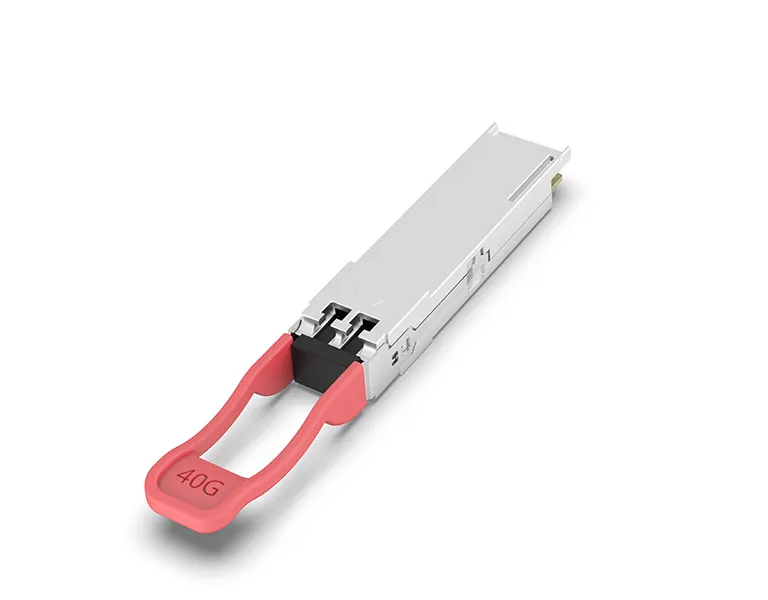
40G QSFP+ Transceiver Main features
The main features of this module include low power consumption, high performance and energy-saving design. It is compliant with QSFP+ MSA (Multi-Source Agreement), IEEE 802.3ba 40GBASE-SR4, and 4x10GBASE-SR standards, and has the convenience of quick interchange. It is widely used in data centers, high-performance computing, and telecommunications fields to meet the needs of modern networks for low-latency and high-bandwidth connections. It uses a multi-mode fiber design that significantly increases bandwidth and is equipped with Digital Optical Monitoring (DOM) technology that allows real-time performance monitoring to ensure reliability and optimal performance in various network environments. The good compatibility with other modules allows it to be easily integrated into the existing network infrastructure, improving the flexibility and scalability of the network.
40G QSFP+ Transceiver Working principle
40G QSFP+ transceivers are known for their excellent performance, reliability and scalability. It uses four independent channels to operate at 40 Gbps, making it ideal for high-bandwidth data center applications. It has a transmission distance of up to 150 meters on OM3 fiber and supports a longer transmission distance of up to 400 meters on OM4 multimode fiber. The device is designed with advanced thermal management capabilities and consumes only about 3.5 watts of power to ensure efficient operation. The module adheres to MSA interoperability requirements and features Digital Optical Monitoring (DOM) capabilities, enabling real-time diagnostics to ensure strong compatibility with a variety of platforms. At the same time, its compact and durable design is particularly ideal for high-density application environments.

40G QSFP+ Transceiver Basic working principle
40G QSFP+ transceivers transmit optical signals over multimode fiber (MMF). On the transmitting end, it converts electrical signals into optical signals, while on the receiving end the reverse process is performed. The device utilizes four parallel optical paths, each capable of transmitting at up to 10 Gbps, resulting in a total bandwidth of up to 40 Gbps. This process relies on the cooperation of lasers and photodetectors to ensure signal integrity and minimize losses during fiber transmission.
40G QSFP+ Transceiver Network performance monitoring and compatibility
Multimode fiber (MMF) Multimode fiber supports high-speed data transmission over short distances. Its core diameter is usually 50 or 62.5 microns and can carry multiple optical modes to increase bandwidth. 40G QSFP+ SR4 transceivers are suitable for data centers and enterprise networks with a maximum transmission distance of up to 150 meters. They are more cost-effective than single-mode fiber and are suitable for high-throughput and budget-constrained application scenarios.
Digital optical monitoring (DOM) provides real-time performance monitoring capabilities to promptly identify potential problems in the transceiver during operation. This technology can collect key data such as optical power, temperature, and laser bias current to help network administrators quickly discover and solve problems, thereby improving the overall reliability of the system and reducing the occurrence of failures. The combination of these two technologies greatly improves the performance of 40G QSFP transceivers, ensuring efficient communication between devices while facilitating real-time monitoring of network performance.
40G QSFP transceivers are compatible with modules from multiple brands, including Cisco, and are particularly suitable for various switches. They are widely used in high-density data centers and enterprise networks. As long as the relevant routers or switches follow the 40G QSFP specifications, the module can be efficiently integrated into the existing network infrastructure, greatly improving scalability and adaptability.
40G QSFP+ Network Edge Data Center Application
As a high-performance optical module, 40G QSFP+ transceiver is widely used in modern network architecture and can meet a variety of needs.
In campus networks, it provides high-speed interconnection solutions for various devices, effectively supporting data transmission and sharing.
In data centers, the excellent performance of 40G QSFP+ ensures the high efficiency of data flow, making various operations within the data center smoother.
In cloud deployment environments, the stability and reliability of 40G QSFP+ transceivers provide a solid foundation for cloud computing services.
In high-performance computing environments: 40G QSFP+ also plays an indispensable role in high-performance computing environments, capable of handling data-intensive applications and large-scale computing requirements, ensuring the efficient use of various computing resources.
Other applications: It is also widely used in the interconnection between switches, routers, servers and transmission equipment, providing a stable connection channel for the entire network system.

40G QSFP+ Transceiver Installation steps
Take the module: First, carefully take out the 40G QSFP+ optical module from the packaging box. Be careful to hold the pull ring end of the optical module properly and avoid excessive force to avoid damaging the module.
Push into the port: Gently align the 40G QSFP+ optical module with the QSFP+ port of the device to ensure that the module is fully in contact with the port connector. During the insertion process, you should hear a "click" sound, indicating that the module has been successfully installed.
Cleaning the interface: Carefully unplug the dust plug on the 40G QSFP+ optical module. Next, a professional cleaning tool is used to thoroughly clean the interface and remove dust and contaminants that may affect the quality of the optical signal. This step is critical to ensure the clarity of the fiber connection and the overall network performance.
Connect the fiber jumper: Insert the cleaned MTP/MPO or LC fiber jumper connector into the interface of the 40G QSFP+ optical module, and ensure that you hear a "click" sound when inserting, indicating that the fiber connection is secure.
Confirm the connection: Please repeat the above steps and make sure to complete the same operation on the other end. When the indicator lights on the switches at both ends turn green, it means that the link has been successfully established and the network connection is unobstructed.
Note: Do not remove the dust plug of the 40G QSFP+ optical module before installing the fiber jumper to avoid contamination of the unprotected interface, which is critical to maintaining the performance of the module.
40G QSFP+ Transceiver Disassembly steps
Disconnect the fiber jumper: Before any disassembly operation, first, disconnect the fiber jumper on the 40G QSFP+ optical module and carefully pull it out to ensure the safety of the operation.
Pull out the module: Next, press the pull ring and slowly pull the 40G QSFP+ optical module out of the QSFP+ port of the device. Please note that you should avoid excessive force to avoid damaging the port interface.
Install the dust plug: Be sure to install the dust plug back to the interface of the 40G QSFP+ optical module to prevent dust and contaminants from invading the interface when the module is not in use, thereby protecting the contact surface of the module.
Proper storage: Finally, place the disassembled optical module securely in anti-static packaging to ensure its safety during storage and transportation, avoiding the influence of static electricity and external factors. By following the above steps, you can effectively maintain the performance of the optical module and significantly extend its service life.
The above is a detailed guide for the installation and removal of 40G QSFP+ optical modules. Mastering these steps can help you achieve efficient network connections in various environments.
In short, 40G QSFP+ modules are an important asset of modern data center architecture, providing reliable and high-speed connections while supporting the needs of today's data-driven applications across network edge data centers and switches.