


Fiber Optic Attenuator
As a kind of optical passive device, the optical fiber attenuator is used to debug the optical power performance in optical communication systems, to calibrate the calibration of optical fiber instruments, and to attenuate optical fiber signals. The product is made of attenuation fiber doped with metal ions, which can adjust the optical power to the required level.
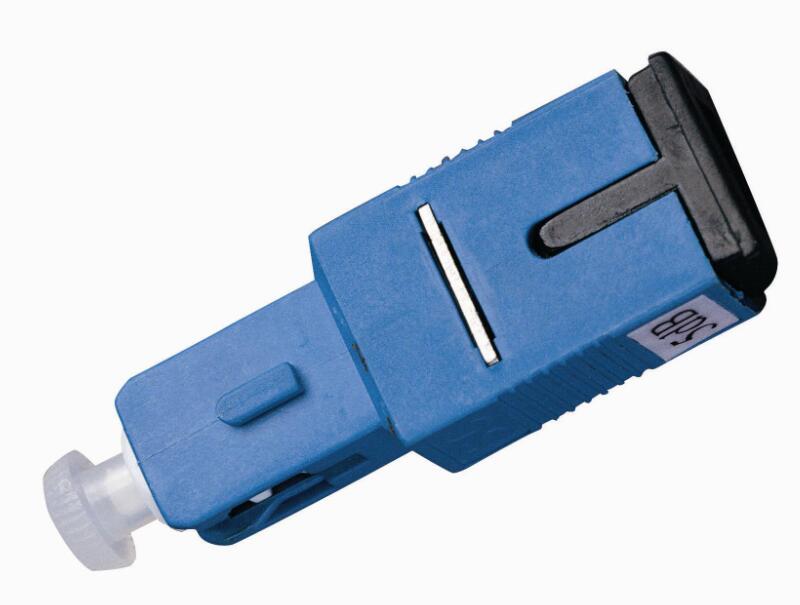
working principle:
1.Air isolation technology
The transmission of light in an optical fiber is restricted by the law of total reflection, which cannot be scattered, and the intensity is relatively stable. And once it is separated from the optical fiber, an air gap is added between the optical fiber and the optical fiber, and the light will be scattered, thereby causing the attenuation of the light. Because light is scattered from the ordinary fiber into the air and is strongly scattered, to control the attenuation range to a certain extent, it is necessary to ensure the isolation distance and maintain the alignment of the two ends of the fiber. Through this principle, flanged fixed attenuators and adjustable attenuators can be made. The flange-type fixed attenuator uses an isolated attenuator, and produces an attenuator of a certain thickness according to the graph. The attenuator is implanted into the flange to fix the light attenuation. The flange-type adjustable optical attenuator uses the principle of mechanical rotation. The distance between the connectors at both ends can be adjusted through mechanical rotation. The optical attenuation can be between 0 ~ 30dB.
2. Displacement and displacement technology. This method is to shift and shift the cores of two optical fibers in a small amount to achieve the effect of power loss.
By using ordinary pigtails, the cores of the two pigtails are fusion spliced with a fusion splicer in the case of misalignment, so that the core is lost during transmission, and a connector-type fixed attenuator is obtained, also known as an online fixed attenuator .
3. Attenuation fiber technology. Based on the absorption effect of metal ions on light, an attenuation fiber with mixed metal ions is developed. Like ordinary fiber, it has an attenuation coefficient per kilometer. This attenuation fiber also has a fixed attenuation coefficient, but this attenuation The coefficient is not calculated in kilometers, but in millimeters. Passing the attenuating fiber into the ceramic ferrule? After special processing, the fixed attenuator can be made into a yin and yang type.
4, absorption glass method
Optically polished neutral absorption glass sheets can also be used in the manufacture of optical attenuators. Using the material's light absorption characteristics, a sheet or strip of neutral dark glass is made and placed on the light path to attenuate the light intensity. Absorptive glass is distinguished by transmittance T and attenuation rate expressed in decibels. Transmission rate T = transmitted light intensity / incident light intensity, attenuation rate η = 1 / T, attenuation rate expressed in decibels β = 10 x logη =-10 x logT, attenuation rate expressed in decibels can be easily estimated The attenuation rate when the slices are combined, the attenuation rate of the superimposed slices is added to the attenuation rate of the combined attenuation slice group, which is expressed in decibels. The flake shape is made a fixed attenuation value, and the strip shape has different attenuation values according to the continuous increase of the dark material inside. A single piece of light-absorbing glass can be used to make a fixed attenuator, multiple pieces of light-absorbing glass can be converted into step-adjustable attenuators through wheel conversion, and strip-shaped absorbers can be made into continuously adjustable attenuators through continuous displacement.
5.Solid-state light attenuation technology
The tunable optical attenuators in the form of air isolation and absorption glass all use mechanical methods to complete the attenuation tunability. There are also a small number of solid-state optical attenuation technologies such as tunable diffraction grating technology, MEMS technology, and liquid crystal technology. , Magneto-optical technology, planar optical waveguide technology, etc.