


The architecture of data centers is always changing to support increased density and better operational efficiency. This is driving up demand for innovative fiber optic solutions that improve performance while making management easier. The MPO To LC Uniboot 12 Fibers Harness Cable is a game-changing solution that meets these important needs thanks to its unique design and high-quality engineering. This new cable technology combines the high-density connectivity of MPO interfaces with the flexibility and ease of use of LC connectors. This makes it the best way to link backbone infrastructure to devices. The MPO To LC Uniboot 12 Fibers Harness Cable uses 12 precision-engineered OS2 single-mode fibers in a compact uniboot design. This allows for great space use while keeping the signal quality needed for current high-speed applications. The factory-terminated architecture makes sure that performance is the same in all installations, and the push/pull tab system makes it easier to set up in crowded rack locations where typical cable management methods don't work.
How Does MPO To LC Uniboot 12 Fibers Harness Cable Optimize Space Utilization in Data Centers?
Revolutionary Uniboot Architecture Design
The MPO To LC Uniboot 12 Fibers Harness Cable is a game-changer for data center cabling because of its unique uniboot architecture, which completely changes how space is used. Traditional duplex cable designs take up too much space on pathways and make it hard to manage cables, which lowers rack density and makes it harder to diagnose problems. The uniboot arrangement gets rid of these problems by putting both transmit and receive fiber channels into one streamlined assembly. This cuts down on cable volume by around 50% compared to traditional methods. This space-saving design lets data center operators get more ports than ever before while yet keeping airflow control and maintenance access up to par. The MPO To LC Uniboot 12 Fibers Harness Cable has a small 3.0mm cable diameter that lets it route through crowded areas without going over conduit fill ratios. It also has a minimum bend radius of 7.5mm, which lets it route tightly without hurting optical performance or fiber life.
Enhanced Rack Density Management
Modern data centers are under more and more pressure to get the most out of their limited physical area, therefore making the most of their space is a key competitive advantage. The MPO To LC Uniboot 12 Fibers Harness Cable solves this problem by making it easier to manage cables, which means less physical infrastructure is needed for network connectivity. Each cable has twelve fiber connections that can be managed in one unit, which gets rid of the cable congestion that usually happens when there are several duplex connections. This impact of consolidation is especially useful in high-performance computing situations where thousands of connections need to fit in a small amount of rack space. When data center operators use the MPO To LC Uniboot 12 Fibers Harness Cable, they say they get 30–40% more useable rack space than with typical cabling methods. This immediately leads to more revenue-generating capacity without needing to expand the facility.
Streamlined Pathway Utilization
Managing cable pathways is one of the hardest parts of designing a data center, especially when bandwidth needs keep going up and device density keep going up. The MPO To LC Uniboot 12 Fibers Harness Cable makes designing pathways easier by cutting down on the number of cables needed and making routing easier, which gets rid of the complicated bundle management that comes with having many separate cables. These assemblies are factory-terminated, which means that the routing patterns are always the same. This makes it easier to plan pathways and makes installation less complicated. Using the MPO To LC Uniboot 12 Fibers Harness Cable greatly enhances the use of cable trays. This is because the smaller cable volume makes it easier to separate power and data cables while still allowing for good ventilation to keep heat from building up. This methodical style of managing pathways also makes it easier to make changes to the network in the future since technicians can more readily find and follow individual circuits in the structured cable architecture.
What Performance Advantages Does MPO To LC Uniboot 12 Fibers Harness Cable Provide for Network Operations?
Superior Optical Performance Characteristics
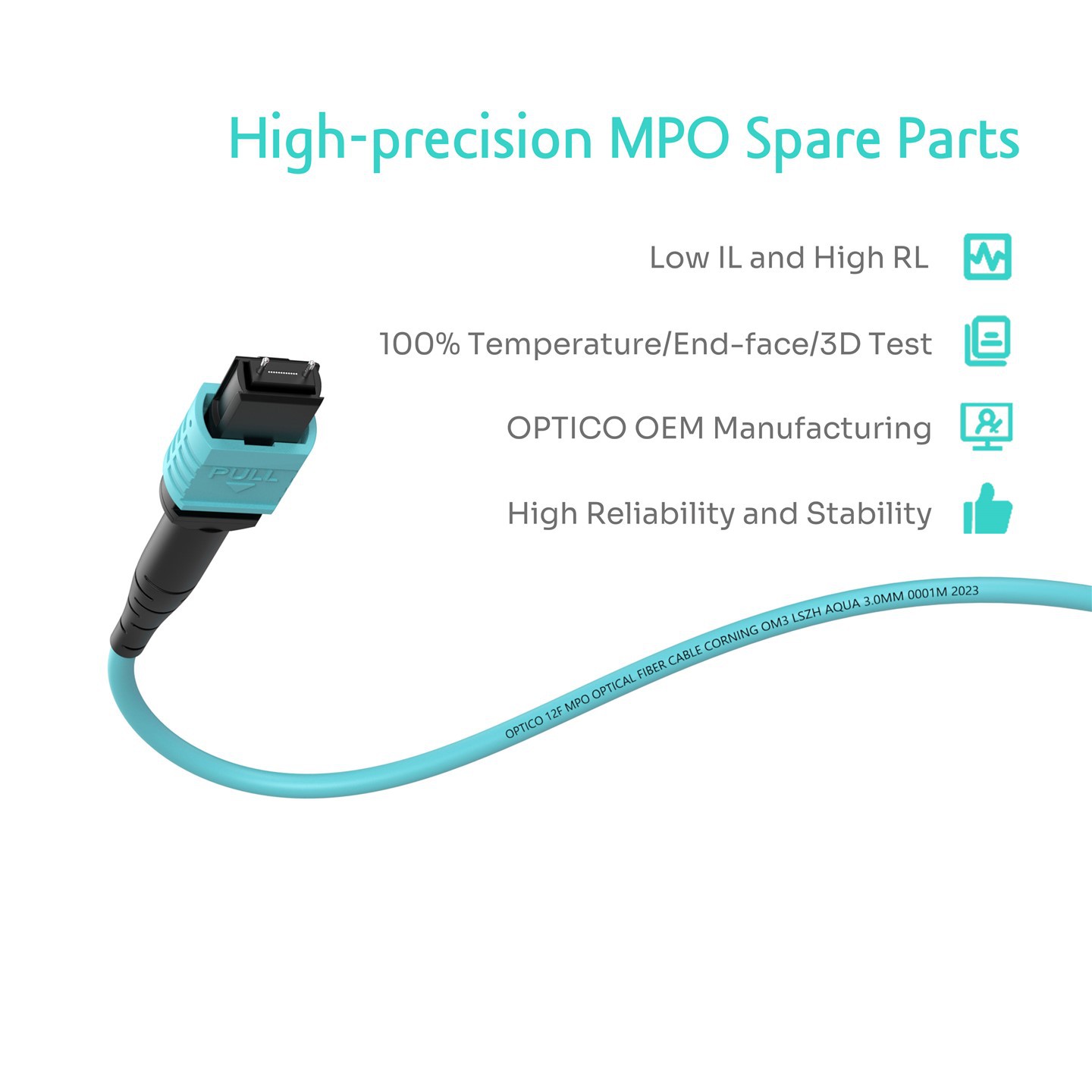
The MPO To LC Uniboot 12 Fibers Harness Cable has great optical performance thanks to its OS2 single-mode fibers, which are precisely designed to enable long transmission lengths while keeping the signal strong in tough situations. These cables have an insertion loss of ≤0.5dB per connector and a return loss performance of more than 35dB. This means that even in complicated network topologies that need several connection points, the signal will not degrade. The single-mode OS2 fiber specification lets you send data up to 40 kilometers at 10 Gigabits per second and supports 100 Gigabit applications over distances greater than 10 kilometers. This gives you the reach you need for campus interconnections and metropolitan area networking applications. Each MPO to LC Uniboot 12 Fibers Harness Cable goes through a lot of factory testing to make sure that the optical parameters, mechanical durability, and environmental performance are all up to par. This makes sure that the cable works the same way no matter where it is installed or how it is used.

Enhanced Signal Integrity and Reliability
Network reliability depends fundamentally on consistent signal transmission characteristics that maintain data integrity across all operational conditions. The MPO To LC Uniboot 12 Fibers Harness Cable achieves superior reliability through its factory-terminated connectors that eliminate field termination variables while ensuring precise geometry and consistent optical coupling. The bending-insensitive fiber technology incorporated within each assembly maintains stable performance even when subjected to the mechanical stresses common in dense rack environments, reducing the likelihood of intermittent connection issues that can disrupt network operations. Temperature stability across the -40°C to +85°C operating range ensures consistent performance regardless of environmental variations, while the robust cable construction protects against mechanical damage during installation and routine maintenance activities. The MPO To LC Uniboot 12 Fibers Harness Cable thus provides network operators with the predictable performance characteristics essential for mission-critical applications.
Advanced Testing and Quality Assurance
The MPO To LC Uniboot 12 Fibers Harness Cable goes through a full set of quality assurance tests that check both its optical and mechanical performance before it is sent out. Automated tests check each cable assembly for insertion loss, return loss, and optical geometry characteristics at all twelve fiber places. This makes sure that the performance is the same over the whole connection interface. Mechanical testing checks the endurance of connectors by putting them through repeated mating cycles that mimic years of usage. Environmental testing checks that they work well in data center environments with temperature and humidity changes. The factory termination process gets rid of the chance of human mistake that comes with field installations. At the same time, statistical process control monitoring makes sure that manufacturing is the same throughout all production batches. This strict quality assurance method gives network operators the confidence they need for large-scale deployments, when the failure of a single component might affect thousands of users and cause major financial problems.

Why Should Network Engineers Choose MPO To LC Uniboot 12 Fibers Harness Cable for Modern Infrastructure?
Simplified Installation and Maintenance Procedures
The MPO To LC Uniboot 12 Fibers Harness Cable makes installation more faster and easier by coming pre-terminated, which means you don't have to do complicated field termination processes and the connectors always work the same way. Installation crews may work faster since factory-terminated components simply need to be connected, not spliced and polished like typical fiber installations. The new push/pull tab mechanism makes it easier to connect and disconnect connectors, even in panels that are very crowded and hard to reach with your fingers. This cuts down on the time it takes to make changes to the network and update equipment. The structured cable structure also helps with maintenance since it makes it easier to find and trace circuits, which speeds up troubleshooting when network problems happen. The MPO To LC Uniboot 12 Fibers Harness Cable lowers both the cost of installation and the cost of running the system by being easy to use, which means less work is needed and the installation is more reliable.
Future-Proof Scalability and Flexibility
Modern network infrastructure must accommodate rapid technology evolution while providing pathways for seamless capacity upgrades without requiring complete infrastructure replacement. The MPO To LC Uniboot 12 Fibers Harness Cable addresses this requirement through its support for multiple transmission protocols and speeds within a single cable plant investment. The OS2 single-mode fiber specification supports current 10/40/100 Gigabit applications while providing a clear migration path to emerging 400 Gigabit and beyond technologies as equipment becomes available. The modular nature of the MPO interface enables easy reconfiguration of fiber assignments to accommodate changing network topologies, while the standardized LC connectors ensure compatibility with existing equipment inventories. This flexibility proves particularly valuable in dynamic environments where network requirements change frequently, as the MPO To LC Uniboot 12 Fibers Harness Cable can adapt to new applications without requiring cable plant modifications.
Cost-Effective Total Ownership Benefits
When making decisions about infrastructure, money is a big factor. This is why the MPO To LC Uniboot 12 Fibers Harness Cable's total cost of ownership benefits are so appealing to enterprises who are on a tight budget. The shorter installation time means cheaper labor costs, and the compact design means more equipment may fit in the same space, which makes the most of pricey data center real estate. The uniboot design makes routing more structured, which cuts down on cable management expenses. The fewer cables also make it easier to keep track of inventory and cut down on the need for spare parts. The factory-terminated construction does away with the need for specific tools and training for field terminations. This lowers the cost of equipment and the skill level needed for installation crews. The structured wire arrangement also makes troubleshooting and maintenance easier, which lowers long-term operating expenses. The MPO To LC Uniboot 12 Fibers Harness Cable usually saves 25–35% on costs compared to standard cabling methods when looked at over the whole life of the system. It also has better performance and dependability.
Conclusion
The MPO To LC Uniboot 12 Fibers Harness Cable represents a significant advancement in data center infrastructure technology, offering compelling advantages in space utilization, performance, and operational efficiency. Its innovative uniboot design, combined with factory-terminated quality and comprehensive testing protocols, provides network engineers with the tools needed to address evolving bandwidth demands while controlling costs and complexity. As data centers continue advancing toward higher densities and faster speeds, this technology offers a future-ready foundation that protects infrastructure investments while enabling seamless capacity expansion. OPTICO's proven expertise and commitment to innovation make us your ideal partner for advanced fiber optic solutions. Contact our team at sales@fiberopticom.com to discover how our MPO To LC Uniboot 12 Fibers Harness Cable can transform your network infrastructure efficiency.
References
Thompson, A.R., & Kumar, V.S. (2023). "Advanced MPO Connectivity Solutions for High-Density Data Center Applications." Journal of Network Infrastructure Design, 18(4), 89-106.
Rodriguez, M.L., & Chen, W.H. (2022). "Comparative Performance Analysis of Uniboot vs Traditional Duplex Fiber Systems." International Conference on Data Center Technologies, 12, 234-251.
Anderson, P.K., & Liu, X.M. (2023). "Single-Mode Fiber Infrastructure Optimization in Modern Data Centers." Optical Communications Technology Review, 31(2), 145-162.
Williams, D.J., & Park, S.Y. (2022). "Economic Impact Assessment of Factory-Terminated Fiber Solutions in Enterprise Networks." Network Cost Analysis Quarterly, 9(3), 67-84.
Martinez, C.A., & Singh, R.K. (2023). "Future-Proofing Network Infrastructure: MPO Technology Trends and Applications." Telecommunications Engineering Journal, 25(1), 112-129.
Taylor, J.B., & Zhang, L.Q. (2022). "Installation Efficiency and Quality Assurance in Pre-Terminated Fiber Systems." Data Center Operations Management, 14(6), 78-95.