


The rapid development of 5G technology and Internet applications has brought about a surge in bandwidth demand and promoted the upgrade of all-optical networks. As a key part of the all-optical network, ROADM and related passive optical devices market is expected to usher in rapid growth. In recent years, ROADM technology has gradually fallen to the metropolitan area network, further increasing market demand.
ROADM can reconstruct the optical add/drop multiplexer, and can download/upload any wavelength combination. With the rapid growth of Internet traffic, traditional ROADM switching nodes cannot meet system requirements. Gradually develop towards colorless / directionless / contention free (CDC).
The most mainstream ROADM structure is shown in Figure 1. The NNI side (interconnection between nodes) is composed of 1×N port WSS, and the UNI side (used for local wavelength upload/download) is composed of a multicast optical switch MCS. An M×N port MCS switch has M input ports and N output ports, and is composed of M 1×N port optical splitters (PS) and N M×1 port optical switches (OSW). The optical signal is input from one of the input ports, and is first divided into N parts by the optical splitter, and broadcast to all N optical switches; then the optical switch corresponding to the target output port selects the received optical signal, and other optical switches ignore it. signal.
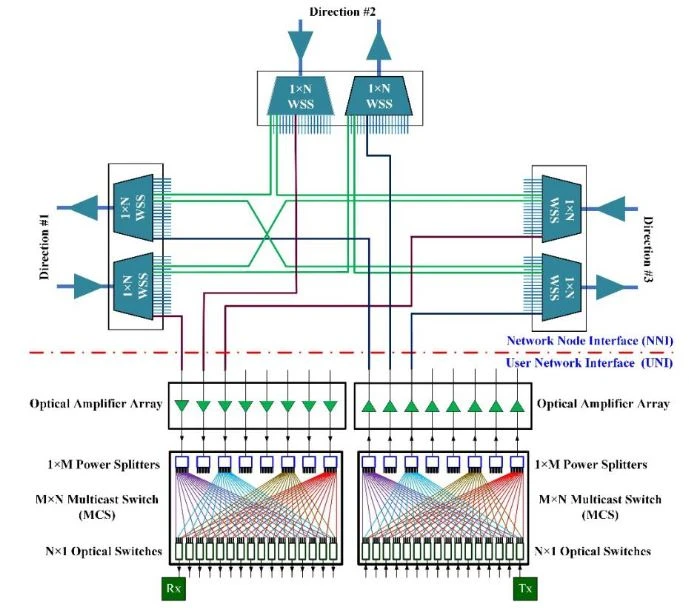
According to the functions of the 1×N port WSS and MCS, this ROADM structure can realize the CDC function. However, the optical splitter in the MCS generates too much loss when splitting and broadcasting, so an optical amplifier array is required to supplement the optical power. It is costly to configure the optical amplifier array. Therefore, the existing EDFA is required to further reduce the size and cost. Optical components in EDFA, such as WDM, optical isolator, TAP coupler, tunable optical attenuator VOA, and photodetector PD, need to be integrated through functional mixing to reduce size and cost.