


Industry Knowledge · ECOC 2026
ECOC 2026: AI Is Driving High Speed Optical Interconnect Upgrades
ECOC 2026 in Málaga highlighted how AI infrastructure is shaping the next phase of optical communications. Higher bandwidth, lower power consumption and greater connection density are driving developments in optical interfaces, packaging and system validation.
The following seven trends provide a useful view of this transition. The practical notes translate these developments into considerations for fiber connection design and testing.

1. AI Infrastructure Becomes a Key Driver
Large AI systems need fast communication between accelerators, servers and data centers. Increasing bandwidth must be balanced with power efficiency and available equipment space. Optical interconnect development therefore involves more than a higher headline speed: it also concerns bandwidth density, link reach and the energy required to transfer each bit.
Practical implication for fiber connectivity
Assess the complete connection path. Connector access, fiber routing, bend radius, insertion loss and maintenance space all contribute to a workable equipment layout.
2. 3.2T Optical Links Move Into Concrete Solutions
3.2T chipset announcements and 400G per lane optical demonstrations show a more concrete development path toward higher capacity links. Transmitters, receivers and signal processing must work together to achieve the required performance. Some enabling components are already available, while readiness for volume deployment must still be evaluated for each complete system.
What to confirm when reviewing a 3.2T solution
Confirm total link capacity, optical lane rate, lane count, wavelength arrangement, reach and interface definition. Fiber count and connector type depend on the actual architecture.
3. CPO and NPO Increase the Focus on System Integration
Co packaged optics (CPO) and near packaged optics (NPO) bring optical engines closer to processing or switching silicon. Their development places more attention on optical engine integration, thermal design and internal fiber connections. CPO platforms were among the technologies presented around ECOC 2026.
In architectures using external lasers, ELSFP, or External Laser Small Form Factor Pluggable, provides a replaceable laser module format with a blind mating optical interface. It supplies laser light to optical engines; the laser delivery path has its own connection requirements.
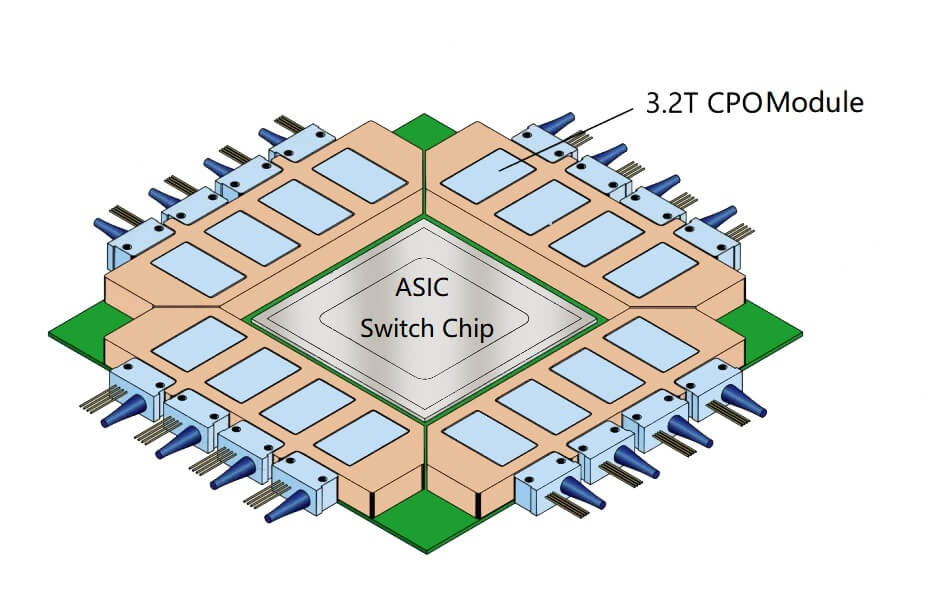
What this means for internal fiber assemblies
Define data paths and laser supply paths separately. Confirm fiber type, connector configuration and channel mapping for each path, including polarization requirements where applicable.
4. 448G Electrical Interfaces Highlight Interoperability
OIF's ECOC 2026 demonstrations included 448G and 224G Common Electrical I/O alongside optical and management interfaces. As signaling rates rise, successful integration depends on the behavior of the complete channel and the ability of components from different suppliers to work together. Interoperability demonstrations provide evidence for specific configurations under defined conditions.
Keep the rate definitions clear
448G electrical signaling, 400G class optical lane rates and 3.2T aggregate capacity describe different aspects of a link. Review the relevant interface, coding and test conditions for each specification.
5. Module and Interface Specifications Address System Needs
Interface development covers mechanical dimensions, thermal requirements, optical connections, electrical characteristics and module management. For example, the ELSFP implementation agreement defines a laser module format and its associated interfaces. These details provide a common basis for integration, replacement and testing.
What to check before selecting a connection
Use the applicable specification revision and mating drawings. Confirm fiber count, guide pins, keying, end face configuration, optical requirements and available installation space.
6. Hollow Core Fiber Moves Toward Practical Deployment
ECOC 2026 topics extended from hollow core fiber production to splicing, monitoring, field deployment and long distance transmission. Discussions also considered integration with existing networks and the standardization challenges involved. This wider focus brings installation and system operation into the conversation alongside fiber performance.

Practical questions for a new fiber technology
Review connection and splicing methods, handling requirements, measurement procedures and compatibility with the intended equipment. Deployment suitability needs to be assessed for the specific fiber and link.
7. Quantum Technologies Explore Optical Network Integration
Quantum technologies, including quantum random number generation, quantum key distribution (QKD) and integrated photonics, serve different roles in emerging systems. ECOC 2026 discussions on QKD and quantum repeaters reflected continuing work toward quantum communication over optical networks, with photon loss remaining a central challenge.
What to consider for network integration
Assess loss, noise and the conditions for sharing infrastructure with conventional optical traffic. The required connection design depends on the quantum protocol and the complete network configuration.
What Should Fiber Connection Designers Focus On?
Our interpretation of these trends is that faster optical systems require closer coordination between interface selection, fiber routing and validation. A practical starting point is to confirm:
1. Interface details: connector family, fiber count, guide pins, keying and end face configuration.
2. Optical requirements: fiber type, operating wavelength, insertion loss, return loss and polarization where required.
3. Routing requirements: channel mapping, fiber lengths, bend radius and connector positions.
4. Test conditions: reference method, inspection procedure and repeatability requirements.
For compact internal routing, a custom Fiber Shuffle can organize fixed fiber paths between defined connection points. MPO/MTP, MMC and SN MT configurations can be selected to match the approved system design.