


Designed for customized high-density optical lane routing
Available in 2×2, 4×4 and 8×8 configurations
Factory-routed fiber mapping for simplified cable management
Supports MTP®/MPO,...

MTP MPO Patchcord
OPTICO - Your Professional Fiber Optic Component Manufacturer

Strong Production Capacity
Operate 3 major production lines totaling over 6000㎡ and produce 300000pcs of MPO per month
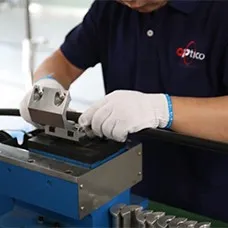
experienced and mature Team
With 15+ years of industry experience, 360 experienced workers, including 30 engineers with 10+ years in fiber optics

One-stop Store for fiber Optic
Provide you a comprehensive data center cabling solution and network accessories

Customization and oEM Service
Tailored products to fit for your business, boost your brand influence with our OEM service
-
![Data Center Shuffling Solution]()
-
![12F AR Coated MPO MTP Trunk Cable]() 12F AR Coated MPO MTP Trunk CableDesigned for high-precision optical testingread more
12F AR Coated MPO MTP Trunk CableDesigned for high-precision optical testingread more
AR-coated non-contact MPO/MTP® interface
Low back reflection and stable optical performance
Compatible with standard MPO/MTP® connectors -
![16F AR Coated MPO MTP Trunk Cable]() 16F AR Coated MPO MTP Trunk CableDesigned for high-precision optical testingread more
16F AR Coated MPO MTP Trunk CableDesigned for high-precision optical testingread more
AR-coated non-contact MPO/MTP® interface
Low back reflection and stable optical performance
Compatible with standard MPO/MTP® connectors -
![72F MPO Fiber Patch Cable OM5]() 72F MPO Fiber Patch Cable OM5MTP/MPO Trunk Cable Series provides a rapid solution for multiple connections, especially for applications as data centers, Ultra Insertion loss 0.25dbread more
72F MPO Fiber Patch Cable OM5MTP/MPO Trunk Cable Series provides a rapid solution for multiple connections, especially for applications as data centers, Ultra Insertion loss 0.25dbread more -
![8 Fibers MPO ST Break Out Patch Cable OM5]() 8 Fibers MPO ST Break Out Patch Cable OM5Product profile OPTICO's MTP/MPO Breakout Cable helps quickly deploy backbone cabling in data centers and other high-density environments, reducing the time and cost of network installation or...read more
8 Fibers MPO ST Break Out Patch Cable OM5Product profile OPTICO's MTP/MPO Breakout Cable helps quickly deploy backbone cabling in data centers and other high-density environments, reducing the time and cost of network installation or...read more -
![12F ELSFP Testing Cable]() 12F ELSFP Testing Cable12F ELSFP Testing Cable is a PM fiber cable assembly designed for external laser source testing in CPO and NPO systems.read more
12F ELSFP Testing Cable12F ELSFP Testing Cable is a PM fiber cable assembly designed for external laser source testing in CPO and NPO systems.read more
It provides stable, low-loss connectivity for ELSFP interfaces. -
![12F MT Ferrule Kit]() 12F MT Ferrule Kit12F MT ferrule kit for MPO connector assembliesread more
12F MT Ferrule Kit12F MT ferrule kit for MPO connector assembliesread more
Supports singlemode and multimode fibers with PC/APC and standard-loss/low-loss options
Compatible with round cable, ribbon cable and... -
![16F AR Coated SN MT Testing Cable]() 16F AR Coated SN MT Testing CableDesigned for high-precision optical testingread more
16F AR Coated SN MT Testing CableDesigned for high-precision optical testingread more
16F SENKO SN-MT connector with AR-coated test interface
Reduced Fresnel reflection and stable, repeatable optical performance
For 400G,... -
![12F AR Coated SN MT Testing Cable]() 12F AR Coated SN MT Testing CableDesigned for high-precision optical testingread more
12F AR Coated SN MT Testing CableDesigned for high-precision optical testingread more
12F SENKO SN-MT connector with AR-coated test interface
Reduced Fresnel reflection and stable, repeatable optical performance
For 400G,... -
![Fiber Shuffle]() Fiber ShuffleDesigned for high-density fiber routing in CPO switches and AI data center optical interconnectsread more
Fiber ShuffleDesigned for high-density fiber routing in CPO switches and AI data center optical interconnectsread more
Customized fiber mapping and routing according to system requirements
Factory-routed,... -
![16F MT Ferrule Kit]() 16F MT Ferrule Kit16F MT ferrule kit for MPO connector housing assembliesread more
16F MT Ferrule Kit16F MT ferrule kit for MPO connector housing assembliesread more
Supports singlemode and multimode fibers, with standard-loss and low-loss configurations
Available in 16F MT PC and MT APC... -
![32F AR Coated MPO MTP Test Cable]() 32F AR Coated MPO MTP Test CableDesigned for high-frequency 32-channel optical testingread more
32F AR Coated MPO MTP Test CableDesigned for high-frequency 32-channel optical testingread more
AR-coated, non-contact MPO/MTP® interface
Reduced reflection and stable IL/RL measurements
MNC-MNC and MNC-MPO...


WHAT IS MTP MPO PATCH CORD?
MPO or MTP fiber patch cables are widely used in high-density cabling environments such as data centers. Traditional tightly buffered multi-fiber cables require a skilled technician to end each fiber individually. MPO cables carrying multiple optical fibers are pre-terminated. Factory pre-terminated MPO/MTP typically have 8, 12, 16 or 24 fiber arrays in one single connector.

01.MPO(Multi-fiber Push On)
MPO stands for "Multi-Fiber Push On. The connector is commonly used to end multiple fiber optic tape connections in indoor environments. MPO connectors comply with IEC-61754-7; EIA/TIA-604-5 (FOCIS 5) standard.
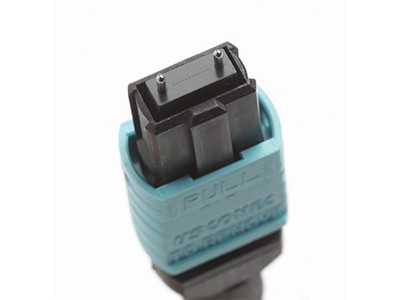
MPO connectors can be male or female. You can identify the male connector by the two locating pins protruding from the end of the ferrules. The MPO female connector will have holes in the ferrule to accept the alignment pin from the male connector.
02. MTP(Multi-fiber Terminal Push-in)
People use the terms MPO and MTP interchangeably. Both MPO and MTP are fiber optic connector types. MTP is the brand name for MPO connectors manufactured by US Conec. Meets MPO specifications. MTP stands for "Multi-Fiber Terminal Push-in" connector. MTP connectors are designed for high mechanical and optical specifications. Some of these features have been patented.
To the naked eye, the difference between the two connectors is minimal. In wiring, they are compatible with each other. All MTPs are MPOs, but not all MPOs are MTPs.
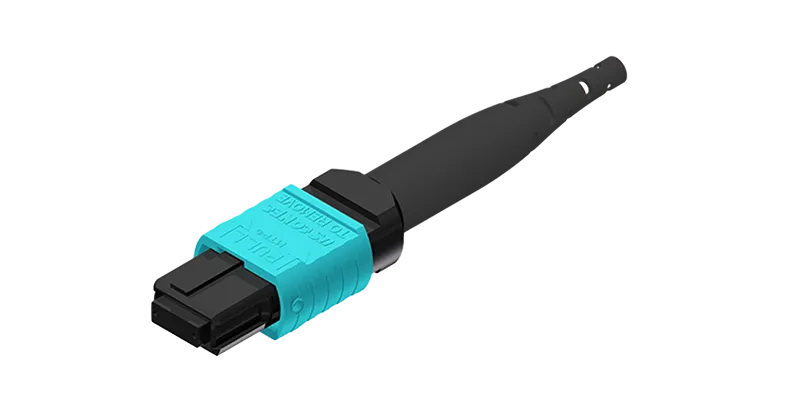
ADVANTAGES OF MTP MPO PATCH CORD
Typically used in data centers, MPO/MTP cable systems feature a modular design that is easy to install, easy to add additional fiber capacity, add higher data rates or expand the network as needed. Read on to learn about the specific areas where MPO/MTP cable systems really make a difference.

Increase cabling density with MPO/MTP cable systems
MTP/MPO connectors are designed to accommodate multiple fibers within a single, compact connector. Unlike traditional connectors that handle one fiber at a time, MTP/MPO connectors can support 8, 12, 24, or even more fibers within a single connector.
Therefore, it is clear that one of the main benefits of migrating to this technology is enhanced data rate performance - a 24-fold increase in the density of MPO/MTP cable systems.
Upgrade from 10G/25G/40G to 100G/200G/400G/800G systems
MPO/MTP breakout cable is the ideal choice for achieving a seamless transition. This type of cable features an MPO/MTP connector on one end and a "branch" with 8/12/16/24 LC connectors on the other.
By integrating these two systems, it reduces the costs and time associated with upgrades and transitions between old and new systems.
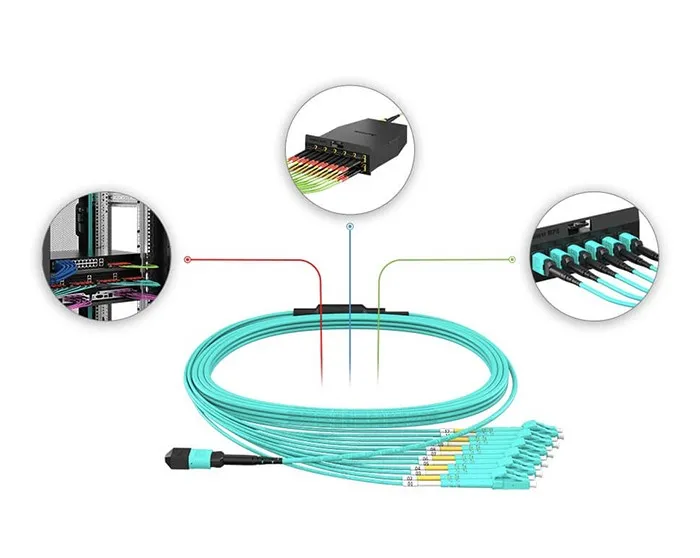

Reduce largely the Number of Cables in your Data Centers
The MTP/MPO Patch Cord introduces a high fiber density design. Instead of managing numerous individual cables, MTP/MPO cables consolidate multiple connections into a single, organized cable assembly. MTP/MPO cables take up less physical space compared to the multiple cables they replace. This results in cleaner and more organized racks, contributing to a neater data center layout and easier maintenance.
The reduced cable volume and streamlined organization contribute to improved airflow within the data center racks. Enhanced airflow not only improves the overall environment but also leads to increased cooling efficiency.
Save your time with Modular Pre-terminated MPO/MTP solutions
MPO/MTP jumpers are precisely manufactured in a controlled factory environment with a high degree of consistent accuracy, which ensure consistent and reliable terminations and erase the variability associated with on-site installation. Their plug-and-play feature facilitates rapid deployment without having to do any tricky on-site splicing.
Besides, the modular approach of the MPO/MTP cable solution, coupled with prefabricated adapter panels and cassettes, further simplifies the cabling process.
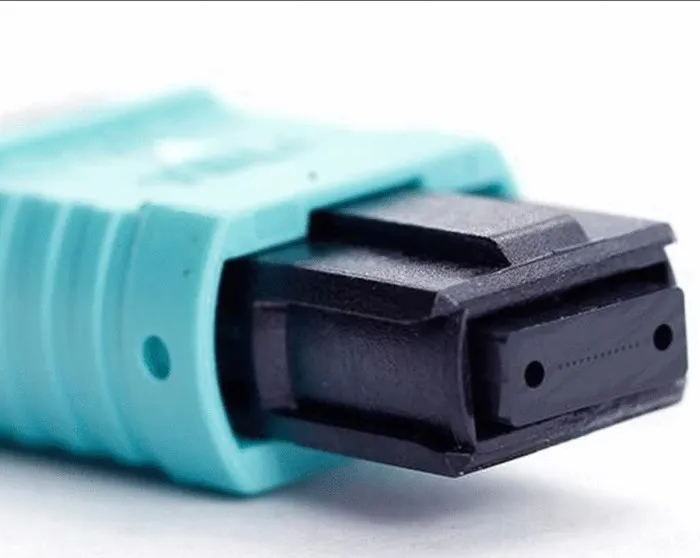

Minimize Signal loss and gain Exceptional Fiber Performance
While the industry standard for MTP/MPO patchcords typically allows for an insertion loss of 0.7dB, our product surpasses expectations with an ultra-low loss of 0.25dB even after 1000 times of mating/unmating. This remarkable reduction in loss ensures that the signal experiences minimal weakening during transmission, resulting in superior fiber performance.
Additionally, our MTP/MPO patchcord is designed to be bend-insensitive, which means that the cable maintains optimal performance even when subjected to bending, contributing to a more robust and dependable fiber optic connectivity solution.
MTP OM5 Patch Cord - The Star of the New Era Data Center
MTP MPO OM5 Fiber Patchcord refers to high density patch cords produced from OM5 multimode fiber. It has a clear effective modal bandwidth (EMB) and low fiber attenuation. It is suitable for low-cost optical signal transmission at wavelengths from 840nm to 953nm. In addition, the MTP OM5 fiber optic patch cord is designed for Short Wavelength Division Multiplexing (SWDM) applications, which means it uses less fiber to achieve high speed transmission. When used in conjunction with SWDM optical modules, MTP OM5 fiber optic patch cords can achieve extremely long transmission distances.

SWDM Technology
MTP OM5 fiber optic patch cable adopts SWDM technology, 40G network (4x10G) only need to use 2 out of 8 cores, 100G network (4x25G) also only need to use 2 out of 8 cores, to provide customers with more efficient solutions.
ultra High Density
In addition, MTP® OM5 connectors support the connection of up to 288 individual optical fibers, and the use of 8/12/24 optical fibers in a single MTP® fiber optic patch cable also reduces cleaning and inspection time. Therefore, MTP® fiber optic cable is widely recognized for its high density cabling.


Longer Transmission Distance
When used with 40G/100G optical modules (400G SWDM4/100G SWDM4), the transmission distance can be extended to 440m and 150m respectively.
OM3/OM4 system compatibility
MTP® OM5 fiber optic patch cords have the same fiber size as OM4 and OM3 cables and are fully compatible with legacy cables. This backward compatibility ensures that data centers can operate well and upgrade smoothly to MTP® OM5 cable systems in their cabling applications.
In short, the MTP® OM5 fiber optic patch cable provides an ideal choice for the growing needs of data centers. Featuring SWDM technology that supports high-speed transmission, reduces fiber core count, and is compatible with existing OM3/OM4 systems, the MTP® OM5 fiber optic patch cord is an efficient and reliable solution for the needs of modern data centers.
TYPES OF MTP MPO CABLES/PATCH CORDS
By Function
Three types of MTP/MPO cable, including trunk cables, MTP®/MPO fan-out cables, and MTP/MPO conversion cables, are well-suited for high-density wiring networks, offering improved network capacity and flexibility.

MTP/MPO Trunk Cables
MTP/MPO trunk cables feature MTP®/MPO connectors (female/male) on both ends, providing users with a choice of 8-144 fibers.
Typically, these multi-fiber MTP/MPO trunk cables are ideal for establishing structured cabling systems, including backbone and horizontal interconnections, such as 40G-40G and 100G-100G direct connections.
MTP/MPO Breakout Cables
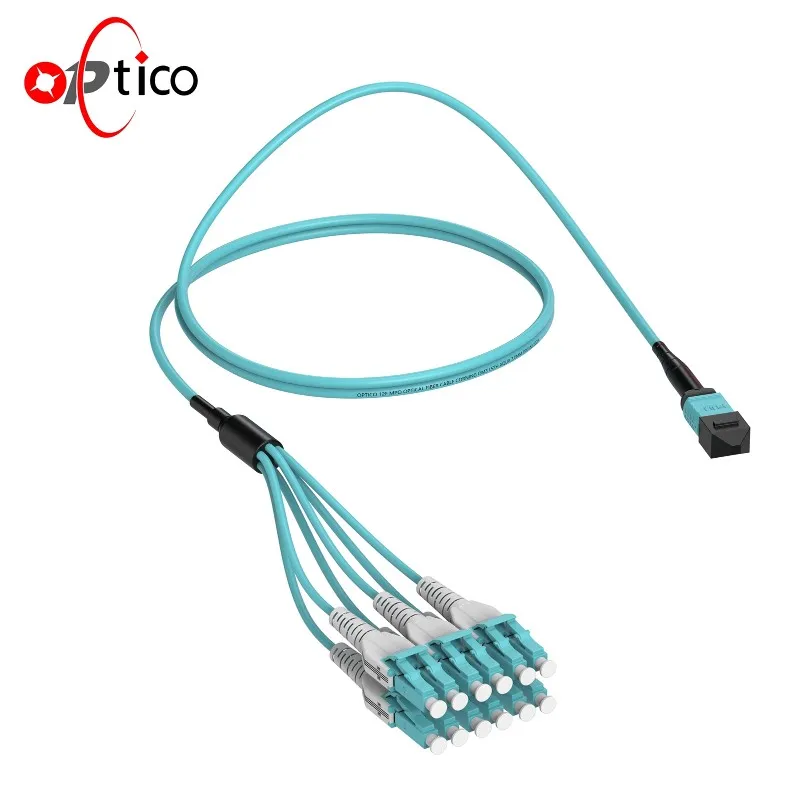
MTP/MPO breakout cables (also known as harness cables or fan-out cables) have one end terminated with female/male MTP/MPO connectors and the other end terminated with 8/12/16/24 or LC/FC/SC/ST connectors, such as 8-fiber MTP/MPO to 4 LC fan-out cable and 12-fiber MTP/MPO to 6 LC fan-out cable.
Typically, these fan-out cables are well-suited for short-distance 10G-40G and 25G-100G direct connections or for connecting backbone components to rack systems in high-density backbone cabling.

MTP/MPO Conversion Cables
MTP/MPO conversion cables share the same fan-out design as MTP/MPO fan-out cables but with different fiber counts and types. They feature MTP/MPO connectors terminated on both ends.
Specifically, commonly used MTP/MPO conversion cables include 24-fiber to 2×12-fiber, 24-fiber to 3×8-fiber, and 2×12-fiber to 3×8-fiber options. They are particularly suitable for 10 G-40 G, 40 G-40 G, 40 G-100 G, and 40 G-120 G connections, eliminating fiber waste and significantly enhancing the flexibility of MTP/MPO cabling systems.
By Polarity
The polarity type of an MTP/MPO cable refers to the specific configuration and arrangement of the fibers in the MTP/MPO cable, creating a difference between the light transmitter and receiver at both ends of the fiber link. Due to the special design of MTP/MPO connectors, polarity issues must be addressed in high-density MTP/MPO wiring systems.
Type
A
Straight-Through Or Key-Up/Key-Down
In type A configuration, the fibers at one end of the MTP/MPO connector are in the same order as the fibers at the other end.
Type
B
Reversed, Cross Or Key-Up/Key-Up
Type B MTP/MPO patchcord has a reversed configuration compared to Type A. The fibers at one end of the connector are in the reverse order compared to the fibers at the other end.
Type
C
Pairs Flipped or Key-Up/Key-Up Flipped
Type C cable has one key-up and one key-down connector on each side, similar to Type A cable. But in Type C, every adjacent pair of fibers at one end is flipped at the other.

2 types of Adapter Connection
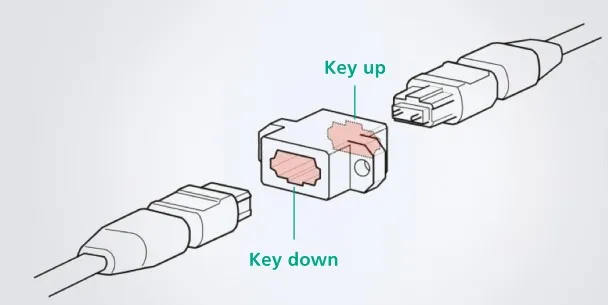
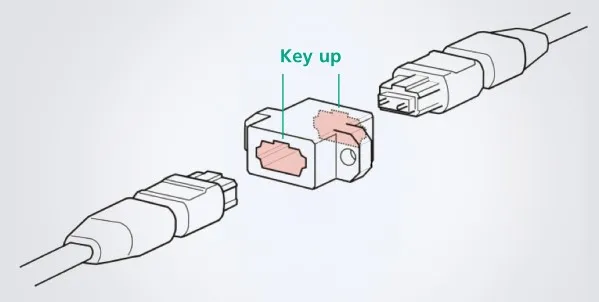
There are generally two types of MTP/MPO adapters according to the placement of the key.
01.
Type A
Key-up to key-down: Here the key is up on one side and down on the other. The two connectors are connected turned 180° in relation to each other.
02.
Type B
Key-up to key-up: Both keys are up. The two connectors are connected in the same position as the other.
By Fiber Counts
The typical MTP/MPO cable has 8/12/24 cores for 40G/100G applications. The latest 16-fiber cable is designed for short-range 400G cabling in hyperscale data centers.


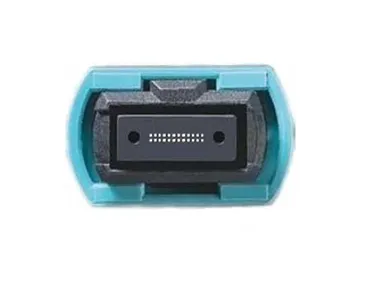

An 8-MTP/MPO cable system is more cost-effective since it can transfer data at the same pace as a 12-fiber line with less money and insertion loss.
The 12-fiber MTP/MPO cable was the first and most widely used 10G-40G, 40G-100G connection option. Four fibers will remain idle if employed in a 40G QSFP+ or 100G QSFP 28 transceiver, leading in poor fiber utilization.
24-fiber MTP/MPO cables are utilized to build a 100 GBASE-SR 10 link between CFP and CFP transceivers.
16-fiber MTP/MPO cables aggregate numerous 8-fiber parallel transceivers and couple directly to16-fiber parallel fiber links, such as 400G QSFP-DD and OSFP.
By Jacket Rating
LSZH (Low Smoke Zero Halogen)
LSZH jackets are designed to minimize the emission of smoke and toxic halogen gases during combustion.
It is ideal for use in confined spaces, such as data centers, where the release of harmful substances could be a concern in the event of a fire.
OFNP (Optical Fiber Nonconductive, Plenum)
OFNP MTP/MPO cables do not contain conductive elements and have the highest fire rating.
It is suitable for installation in buildings' plenum spaces, which are areas with air circulation for heating, ventilation, and air conditioning (HVAC) systems.
CMP (Communications Multipurpose Cable, Plenum)
CMP MTP/MPO cables limit flame propagation and smoke exhaust speed during a fire.
CMP jackets meet strict fire safety standards and are suitable for installation in plenum spaces.

Parts of mTP MPO Connector
The boot and crimp ring are used to support and ensure that different types of fiber are secured to the connector. The tail sleeve is used to prevent bending, which can also indicate the number of fibers by different color codes.The inner housing and outer housing hold the spring and connector together to ensure a good connection.
The core of the MPO connector is the precision-molded MT ferrule. According to the tolerance of the optical fiber and the alignment pinhole, the ferrule determines the performance level of the MPO connector, and also the number of optical fibers terminated in the MPO connector.
Main Applications of MTP MPO Patchcord
01.
Data Center Connectivity
MTP MPO patch cables are extensively used for connecting networking equipment, such as servers, switches, and routers, in data centers. They facilitate quick and efficient data transmission, supporting high-speed applications.
02.
Telecommunications Infrastructure
MPO patch cord plays a vital role in telecommunications networks, providing a compact and organized solution for fiber optic connections. They are employed in both local and long-distance communication infrastructure.
03.
Backbone Cabling
MPO MTP trunk cable is often used in backbone cabling systems to connect different parts of a network. Their high fiber count and density make them suitable for efficiently managing and transmitting data across the network backbone.
04.
Parallel Optics Systems
MPO fiber patch cord is well-suited for parallel optics systems, where multiple fibers are used simultaneously to increase data transfer rates. They are commonly used in applications such as InfiniBand and Ethernet.
Essential MPO tests
There are three essential tests you should always perform to ensure the quality of your link: 1) polarity-type validation, 2) continuity confirmation, and 3) inspection.
1)Polarity
As we mentioned earlier, polarity of an MTP MPO cable simply refers to the way fibers are arranged inside the cable. Each element in an MPO system—trunk,adapter and patch cord—is individually classified by Type A, B, or C and contributes to maintaining polarity.
Type A and B are the most common types of polarity used in data centers and CORDs while Type C is more typical of duplex applications. However, no one polarity type is better than another. Knowing which is appropriate depends on your architecture’s design. Different equipment manufacturers or applications might require different polarity types.
Each individual MPO element (trunk, adapter, patch cord) is classified by type (A, B, or C) and contributes to maintaining the required polarity so that the right transmitter communicates with the right receiver. But when referring to the end-to-end system, standards refer to the “connectivity method,” which can also be A, B, or C. This should not be confused with the type of each individual element. An A, B, or C connectivity method corresponds to the type of the MPO trunk cable only.
For example, a Method A connection for end-to-end parallel signals will use 1 Type A trunk, 2 Type A mating adapters, 1 Type A patch cord on one end, and 1 Type B patch cord on the other end.
Why is it important to validate polarity? Your main goal is to make sure the right transmitter (TX) goes to the right receiver (RX). To accurately send and receive data, it is critical that MPO connectors be properly aligned and mated. Bad coupling will impede signal transmission, as the signal could be sent in the wrong direction.
It’s also important because a single cable with a polarity type different from the rest can change the polarity of the entire link. For example, if all your elements are Type A (cable, mating adapters, etc.), but one element is Type B, then the whole link becomes Type B. As a rule of thumb, Type A elements maintain the polarity, while Type B elements will reverse the polarity.
Moreover, when working with a fanout cable, it’s important to be aware of polarity to make the right connections, or you could end up with a different polarity type.
2)Continuity Confirmation
Confirming the continuity of a link ensures that there is no break, and that light travels properly all the way to the end of the link under test. It’s a quick validation test that, when done during installation, can save a lot of time in potential troubleshooting later.
3)Inspection
With MPO connectors, inspecting and cleaning is particularly important because each port represents a potential point of failure. Additional fibers create more surfaces, which means there is a higher risk of contamination and failure. Bad connectors are a significant cause of loss, and the impact is ever greater for MPO links in which a single dirty or damaged connector can affect as many as 12 or 24 fibers.
What’s more, to guarantee that your network is futureproof and can meet the ever-increasing demand for bandwidth, it becomes crucial to ensure connectors are in good condition. With all the different types of connectors on the market, having a single tool to inspect all types of MPO cables—including multimode or singlemode fibers, APC, UPC male (pinned) and female (unpinned) connectors—can greatly simplify network testing.

This flowchart walks a technician through the process of inspecting, cleaning if necessary, and reinspecting fiber ferrules, before connecting.
How to clean mPOs
The method for cleaning MPO connectors is to inspect, clean, and reinspect.
Inspect
Always inspect the connector first. You don’t need to clean a connector if it’s already clean, as cleaning it might actually make it dirty. This is especially true for MPO connectors, which are highly sensitive. For example, the pictures on the right illustrate different types of MPO connector contamination.
Make sure to inspect both mating connectors, as residue from a dirty connector will transfer to a perfectly clean connector once they mate.
High-performance inspection tools and solutions on the market are better than ever. They allow you to do the following:
- Inspect single-fiber and multifiber cables using the same tool by simply switching the adapter
- Take advantage of a slim design to easily access recessed connectors and dense panel settings
- Get an automated analysis of all fibers or multifiber cables and obtain a clear pass-or-fail result according to your testconfiguration

Clean

In general, there are two methods to clean fiber optic connectors: dry cleaning and wet cleaning. Dry cleaning is done by using a roll-type box cleaner or push-type fiber optic cleaner to wipe the connector face with a dry cleaning cloth in one direction. It can remove pollutants from the air and should be tried first. As for wet cleaning, first wipe the end face in the wet area and then wipe the end face in the dry area to clean the potential residue on the end face.
Dry cleaning is recommended because wet washing can damage equipment. For example, wet cleaning is highly discouraged for receptacles and bulkheads.
Wet washing is more aggressive than dry cleaning, but it removes pollutants and light oil residues from the air. After dry cleaning, if the connector still has stubborn stains, try a mixed cleaning method that includes the use of a solvent.
reinspect
Be sure to dry the connector after using the wet cleaning tool, and to recheck the MPO connector using a fiber optic inspection scope. Simply looking at an image to determine if a fiber is clean can be difficult and subjective. Automated analysis makes testing simple, eliminates guesswork, conforms to standards, and provides consistent results for all technicians, regardless of their experience or training. Moreover, by generating results reports, you can ensure that you leave a record of your tests and avoid unnecessary troubleshooting in the future.
FAQ
Q: Are MPO and MTP interchangeable?
A: MPO is a fiber optic connector – MPO standing for “Multi-fiber Push On” which was originally developed and licensed by NTT Group. Licensing led to several variants of MPO, and MTP®, meaning “Multi-Fiber Termination Push-on” and trademarked by US Conec for their MPO connector, provided some added functionality over MPO in the early years of development. However, over the years the divergence between the two types of connectors has narrowed, with many MPO connectors now offer the same performance and even additional features over MTP. MPO and MTP connectors are 100% compatible and interchangeable. MPO and MTP connectors both conform to SNAP (form factor and multiplex push-pull coupling) and are fully compliant with IEC-61754-7 and TIA-604-5 (FOC155).
Q: Is MTP better than MPO?
A: The distinction between MTP (Multi-Fiber Termination Push-On) and MPO (Multi-Fiber Push-On) lies in the trademark. Functionally, both MTP and MPO connectors serve the same purpose, offering high-density multi-fiber connectivity. The choice between them depends on the application requirements, cost considerations, and adherence to specific standards. In practice, people often use the terms interchangeably, but it's essential to understand the specific context and whether adherence to US Conec's standards is necessary for the given application.
Q: How should I choose between MPO and MTP?
A: In essence, the choice between MTP and MPO depends on the specific requirements of the connection scenario. MTP and MPO have their own advantages depending on the specific needs of the application. MPO connectors have a wider availability and may be more cost-effective on some projects. MTP can better meet the requirements for high performance and high reliability, but it will also be relatively more expensive. Besided, don't forget to ensure compatibility with existing infrastructure and check the availability of connectors from your preferred supplier.
Q: Can MPO/MTP patch cords be customized for specific applications?
A: Yes, all COPTICO's MPO/MTP patch cords offer extensive customization options to suit specific applications. Fiber counts, connector types (MPO or MTP, male or female), fiber modes (single-mode or multimode), cable lengths, jacket types (LSZH, OFNR, OFNP, PVC), connector polarity and so on, are among the parameters that can be tailored to meet the unique requirements of your network or data center.
Shenzhen Optico Communication Co., Ltd. is one of the leading mtp mpo patchcord manufacturers and suppliers in China, featured by quality products and good service. Welcome to wholesale customized mtp mpo patchcord form our factory. Also, free sample is available.
mtp patchcord, 96F MTP MPO Trunk Cable, mtp mpo fiber breakout cable