



Shenzhen Optico Communication Co., Ltd. is one of the most credible manufacturers and suppliers of 24f mtp to lc breakout cable in China. Please feel free to wholesale high quality customized products at competitive price form our factory. If you have any enquiry about free sample, please feel free to email us.
Product Profile
- This 24F MTP to LC Breakout Cable can expand a single-end 24-core MTP connector into 12 LC duplex connectors, easily completing the branching cabling from high-density backbone links to terminal devices. All components are pre-terminated in the factory and undergo full optical testing before leaving the factory, rigorously ensuring excellent insertion loss, return loss performance, and long-term operational reliability.
- The 24F MTP to LC Breakout Cable eliminates the need for on-site termination and splicing, simplifying construction and reducing labor costs. It significantly improves overall network transmission integrity and system stability, making it suitable for high-density fiber optic networking scenarios such as data centers, structured cabling in server rooms, 5G base stations, and high-speed backbone networks.
Product Specifications
| Physical Properties | Parameter | ||
| Fiber Count | 24 | ||
| Fiber Mode | SM(OS2)/MM(OM3/OM4/OM5) | ||
| Connector Type | US Conec MTP Female | ||
| Polarity | Type A/B/C | ||
| Cable Jacket | PVC/LSZH/OFNP | ||
| Jacket Colour | Yellow/Aqua/Magenta/Lime Green/ Custom | ||
| Cable Diameter(mm) | 3 | ||
| Minimum Bend Radius | 7.5 | ||
| Fiber and Boot Length | Customizable | ||
| Optical Properties | Parameter | ||
| Insertion Loss(dB) | Standard Loss | Low Loss | Ultra Low Loss |
| ≤0.7 | SM ≤0.35, MM ≤0.5 | ≤0.25 | |
| Return Loss(dB) | SM ≥ 60, MM ≥ 20 | ||
| Wavelength(nm) | SM 1310/1550, MM 850/1300 | ||
| Tensile Strength(N) | Long Term | Short Term | |
| 70N | 220N | ||
| Operating Temperature(°C) | -20 ~ +70 | ||
| Storage Temperature(°C) | -40 ~ +85 | ||
Product Features

Bend Insensitive Fiber
Adopts bend-insensitive fiber structure, tolerates small bend radius, effectively avoids micro-bend loss, and suits complex and dense cabling deployment.

8° APC End-face Polishing Technology
Comes with standard 8° APC precision polishing, greatly suppresses optical return reflection and reduces signal distortion, meeting strict optical requirements of IB NDR transceivers.

Multi-environment High-density Cabling
Compact structural design enables integrated multi-channel optical routing, ideal for high-density deployment in data centers, server cabinets and other scenarios.

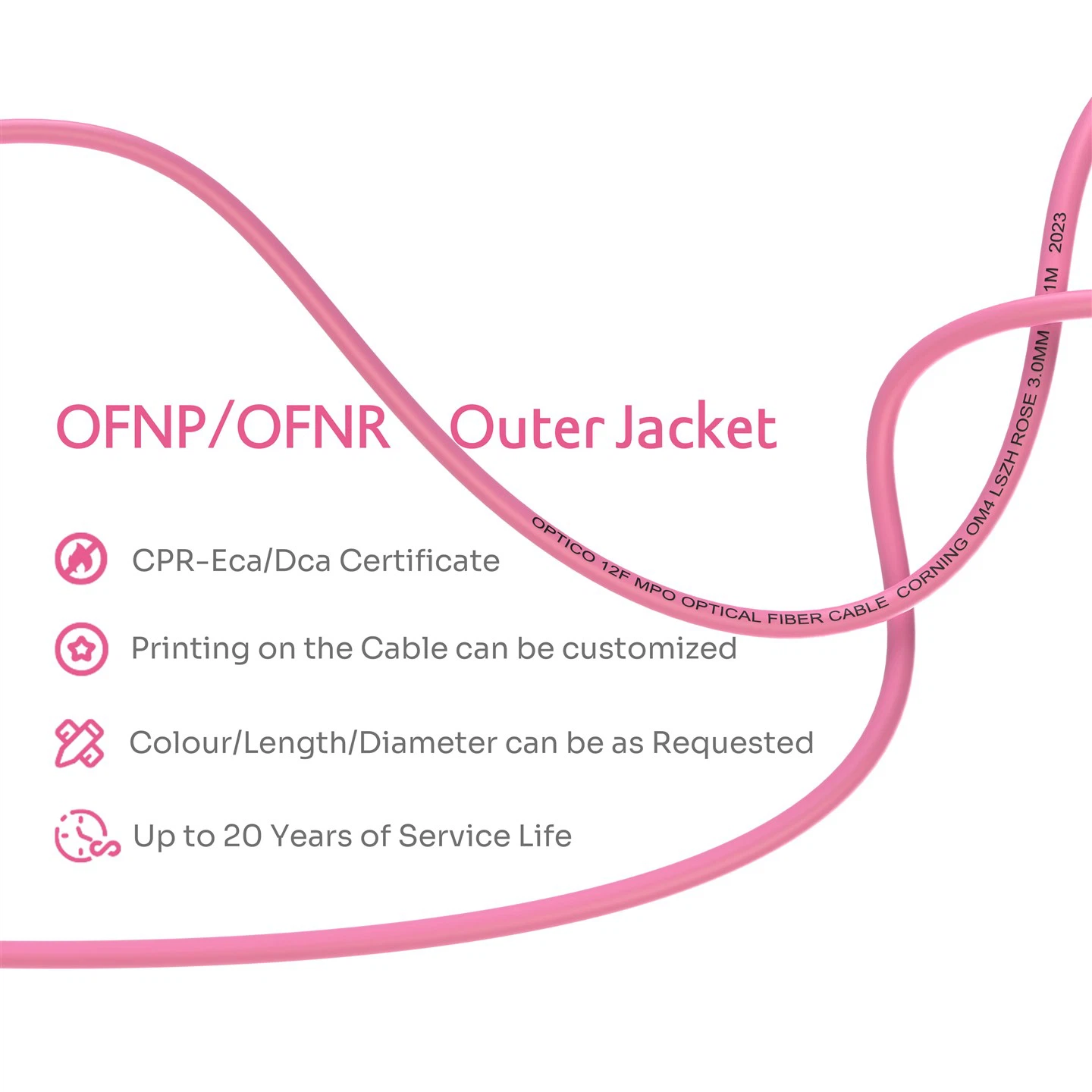
OFNP Fire-rated Jacket
Optional OFNP plenum-rated jacket allows direct installation in ceiling air handling spaces, compatible with OFNR riser-rated and general cabling applications for superior fire safety compliance.
Product Applications

High Density Data Center


Optical Module Connection
100% Tested Before Delivery
Our products undergo comprehensive testing before shipment to ensure high-quality delivery to our customers.

MPO IL RL Test

MPO Polarity Test

MPO End-surface Test

Temperature Test
Certificates

CE
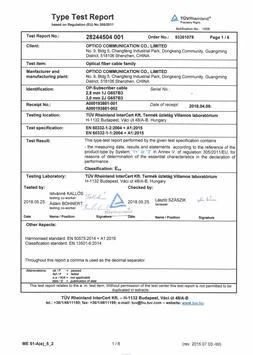
CPR
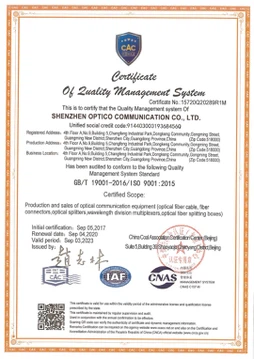
ISO

RoHS
fAQ
Q:1.What is the difference between MTP and MPO?
A:MPO is a universal fiber optic connector standard, while MTP is an upgraded version of MPO, featuring a removable housing, adjustable polarity, better dust protection, and compatibility with repeated mating and unmating. Both have the same interface and are compatible.
Q:2.What is Type B Cross Polarity in MTP fiber cables?
A:Type B, also known as cross-polarity, is the standard fiber sequence arrangement for MTP patch cords. Its characteristic is that the fiber cores at both ends of the patch cord are reversed. Taking a 12-core MTP connector as an example, fiber core 1 on one end corresponds to fiber core 12 on the other, and fiber core 2 corresponds to fiber core 11, with the ends arranged in a cross-polarity pattern. This unique reverse cross-polarity structure meets parallel optical link cabling specifications, ensuring accurate transmission and reception of 40G and 100G high-speed network signals and guaranteeing stable and smooth overall link transmission.
Q:3.What are the key differences between OM5, OM4, and OM3 MTP fiber cables?
A:OM3, OM4, and OM5 are multimode optical fibers of different specifications, with significant differences in bandwidth and transmission distance. OM3 and OM4 are only compatible with 850nm VCSEL light sources, with bandwidths of 2000 MHz·km and 4700 MHz·km, respectively. OM5 broadband multimode optical fiber, which also has a bandwidth of 4700 MHz·km, not only supports SWDM technology and is compatible with 850–950nm multi-wavelength transmission, but also perfectly adapts to various high-speed network applications due to its wider wavelength adaptability.
Q:4.Are the losses at different end faces the same for single-mode and multi-mode systems?
A:They are different. Single-mode PC connectors have a standard loss ≤0.35dB and a low loss ≤0.20dB; APC connectors have a standard loss ≤0.35dB and a low loss ≤0.20dB; multi-mode PC connectors have a standard loss ≤0.35dB and a low loss ≤0.30dB.
Hot Tags: 24f mtp to lc breakout cable, China, manufacturers, suppliers, factory, wholesale, customized, mtp om4 patch cord, 12 fiber om4 cable, mpo fiber jumper, MTP MPO Patch Cable, om3 multimode fiber, mtp mtp jumper
| Physical Properties | Parameter | ||
| Fiber Count | 8/12/16/24/32/48 Fibers / Custom | ||
| Fiber Mode | SM(OS2)/MM(OM3/OM4/OM5) | ||
| Connector Type | US Conec MTP Female/Male; MPO Female/Male | ||
| Polarity | Type A/B/C | ||
| Cable Jacket | PVC/LSZH/OFNP | ||
| Jacket Colour | Yellow/Aqua/Magenta/Lime Green/ Custom | ||
| Cable Diameter(mm) | 3 | ||
| Minimum Bend Radius | 7.5 | ||
| Fiber and Boot Length | Customizable | ||
|
|
|||
| Optical Properties | Parameter | ||
| Insertion Loss(dB) | Standard Loss | Low Loss | Ultra Low Loss |
| ≤0.7 | SM ≤0.35, MM ≤0.5 | ≤0.25 | |
| Return Loss(dB) | SM ≥ 60, MM ≥ 20 | ||
| Wavelength(nm) | SM 1310/1550, MM 850/1300 | ||
| Tensile Strength(N) | Long Term | Short Term | |
| 70N | 220N | ||
| Operating Temperature(°C) | -40 ~ +85 | ||
| Storage Temperature(°C) | -20 ~ +70 | ||


